Cryptography: theory
In this material, the study of cryptography is primarily intended to take place in the module Applied cryptography. Largely the same topics are presented in CyBOK v1.1 at a theoretical level at this point (Chapter 10), but this course material does not include that content. Instead, it only provides some general explanation and motivation, as well as an example serving as one kind of introduction, which is likely to be useful. On the other hand, students are encouraged to consult the source work as they progress to later courses, several of which are offered at Tampere University specifically in the field of cryptology.
In the theory of cryptography, emphasis is placed on mathematics and on modelling security through the properties of an abstract attacker. Modelling likewise requires mathematical competence, as it involves probabilities, uses logic, and often results in rather complex notation. After seeing a few such presentations, for example security proofs, one may notice that there is considerable regularity in the notation and probability expressions, which makes further learning easier.
Mathematical structures
The mathematics of cryptographic algorithms requires understanding the concept of algebraic structure. The integers with operations +, −, and × already form a structure, but initially this must be refined into one where division is also defined between all elements (although division by zero is still not possible and must not be allowed). For this purpose, we restrict ourselves to the integers 0, 1, 2, …, p−1, where p is a prime number. These are modular integers, for which +, −, ×, and ÷ are defined. All operations except ÷ proceed “in the usual way”, provided that the result is reduced modulo p, in other words by adding p or −p as many times as needed to obtain a value in the range 0,…,p−1.
For example, if p=11, then 5+6=0, 4−7=8, 3×5=4, and 10×10=1. The last result means that 10 is its own multiplicative inverse modulo 11. A similar property always holds for q−1 when q is a prime: (q-1)×(q-1) = q2- 2q + 1 = 0-0+1 = 1 modulo q.
For the operation ÷, a new algorithm is required, but this is no different from how division had to be learned earlier in school. Progress here is made via multiplicative inverses. When p is prime, the inverse of a number a, denoted a-1, can be computed as ap-2 modulo p. Try calculating 109 mod 11 with a calculator. The Euclidean algorithm is much faster for large numbers.
Applying the above example, we observe that modulo 11, 4÷5=3, 1÷10=10, and 2÷10 = 2×10=9. What we have here is a structure called a finite field. In cryptology, there are also finite fields not consisting of numbers. (They consist of vectors whose elements are coefficients of polynomials, but we will not go into these now; instead we turn to certain pairs of numbers.)
The next step in cryptographic mathematics leads to structures consisting of pairs of modular integers. Operations + and −, as well as multiplication by a scalar (an integer), are defined for them. This would otherwise resemble the analytic geometry familiar from school, but the new step is to restrict the points (x,y) to those satisfying the equation y2 = x3+1 (or a similar equation where y is squared and x is cubed). It turns out that the operation between two points produces a new point that satisfies the same equation (provided that one point is imagined at infinity). The points form an algebraic structure called an elliptic curve. These too are finite, although the ones used in cryptography contain more points than there are atoms in the universe, as far as is known. Large numbers and sets are necessary in cryptology to prevent exhaustive search. Quantum cryptography uses different techniques and different mathematics. This will be discussed shortly, but even quantum computing is not overly difficult, if one is to believe the Canadian university high school quantum summer course (QSYS) background material (feel free to order it! It begins with complex numbers, revisits vector spaces, and then introduces quantum states and gates, tensor products, measurements, and probabilities).
Post-quantum
Post-quantum cryptography (PQC) refers to encryption methods designed to be secure even against quantum computing. They can, however, be implemented on traditional computers, and there is no need to understand qubits or tensor products. From the perspective of the user or application developer, they function like traditional encryption or signature methods. PQC algorithms are already available in many browsers and operating systems.
From the theory of computation it is known (though not yet in practice as of 2026) that quantum computers can solve certain mathematical problems easily while others remain difficult even for them. Quantum computers are effective at factoring integers, which breaks algorithms such as RSA. In addition, quantum computers can break elliptic curve cryptography, meaning that the most common public-key encryption and signature methods of the 2020s are vulnerable. Attacks on symmetric encryption and hash functions (AES, SHA) using quantum computers are less effective.
The first PQC methods to be deployed are based on lattice and coding theory. A lattice resembles a multidimensional vector space but is a discrete subset of one, much like integers are a discrete subset of real numbers (a 3D analogy can be formed from the atomic lattice of a crystal). Among the new lattice-based algorithms, the most important are ML-DSA for digital signatures and the public-key encryption and key exchange method ML-KEM. Both have the status of international standards.
Preparing for the development of quantum computing is necessary even before practical attacks materialise, as encrypted communications can be collected now and broken later (“harvest now, decrypt later”). For this reason, migration to PQC—especially for key exchange—has been accelerated and is already widely used in TLS encryption, whereas the transition to ML-DSA certificates has been slower. In the EU, the transition to PQC is required to be completed by 2035. Similar security guidance applies in the United States and other Western countries, making the transition global.
Protocol
Finally, we consider an example that complements the presentation in the module on applied cryptography. The figure shows a cryptographic protocol, that is, an exchange of messages between the parties Alice and Bob. It produces for them, that is, for A and B (cf. also the subscripts of symbols), a shared symmetric key K such that each can be sure of with whom it has been established. The name of this protocol is Station-to-Station, and it is a basic case of authenticated key exchange. Here, the aim is primarily to clarify the notation used in cryptographic presentations. There is no need to worry even if the explanation following the figure does not fully clarify everything. After all, encryption and signature schemes will only be studied later.
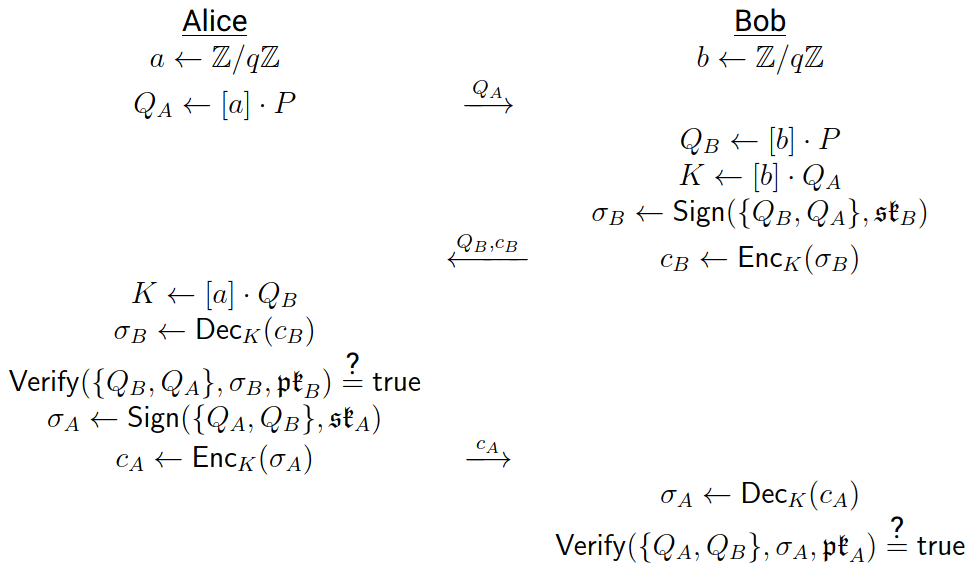
From the centre of the figure, you can see that A and B send a total of three messages to each other, of which B’s message to A contains two data elements (separated by a comma). The rest describes the computation. The longest line on each side is signature verification, where the ? above the equality sign indicates the question of whether the verification succeeds, that is, whether equality holds. The diagram does not indicate that A would terminate if verification failed. This is typical of protocol descriptions; in an implementation, this cannot be ignored.
Next, locate the second longest line on each side and compare them with the previous ones. You will notice that the Sign-function outputs a signature denoted by σ (sigma), which is then provided as input to the Verify function on the opposite side. The symbols sk and pk, written in a distinctive font, refer to the parties’ (as indicated by the subscript) private and public keys (secret key and public key). What is signed is not completely symmetrical on both sides, since B does not yet have as much information at its stage as A, which computes its signature also based on B’s signature σB. On the preceding line, A has decrypted it from the ciphertext cB using the key K, which A has just determined on the line before that. B learned this slightly earlier. You should be able to find the line where this occurs. B applies the key in the EncK function, i.e. encryption, while A uses the DecK function, i.e. decryption. Later, the roles are reversed when A sends its signature (σA) encrypted as cA, and B decrypts it for verification.
Signature verification is the part that ensures the authenticity of the parties. Let us still examine how the shared key K is formed. Initially, each party generates a random element (the numbers a and b) from the set Z/Zq, which is a finite field with q elements (sometimes denoted GF(q)). On the following lines, each computes a multiplication in which P is a publicly known point of an elliptic curve—and the curve itself is of course known, as is the large prime q. The numbers a and b are shown in brackets in the multiplication to emphasise that here they are ordinary integers, whereas earlier they are elements of the field (and the field could be more complex). In any case, by following the computation, you can see that both ultimately compute K as the same element [a]·[b]·P. The fact that an eavesdropping attacker cannot determine K is the key insight of this part of the protocol, dating back to the 1970s. See more in the section Diffie–Hellman–Merkle key exchange.